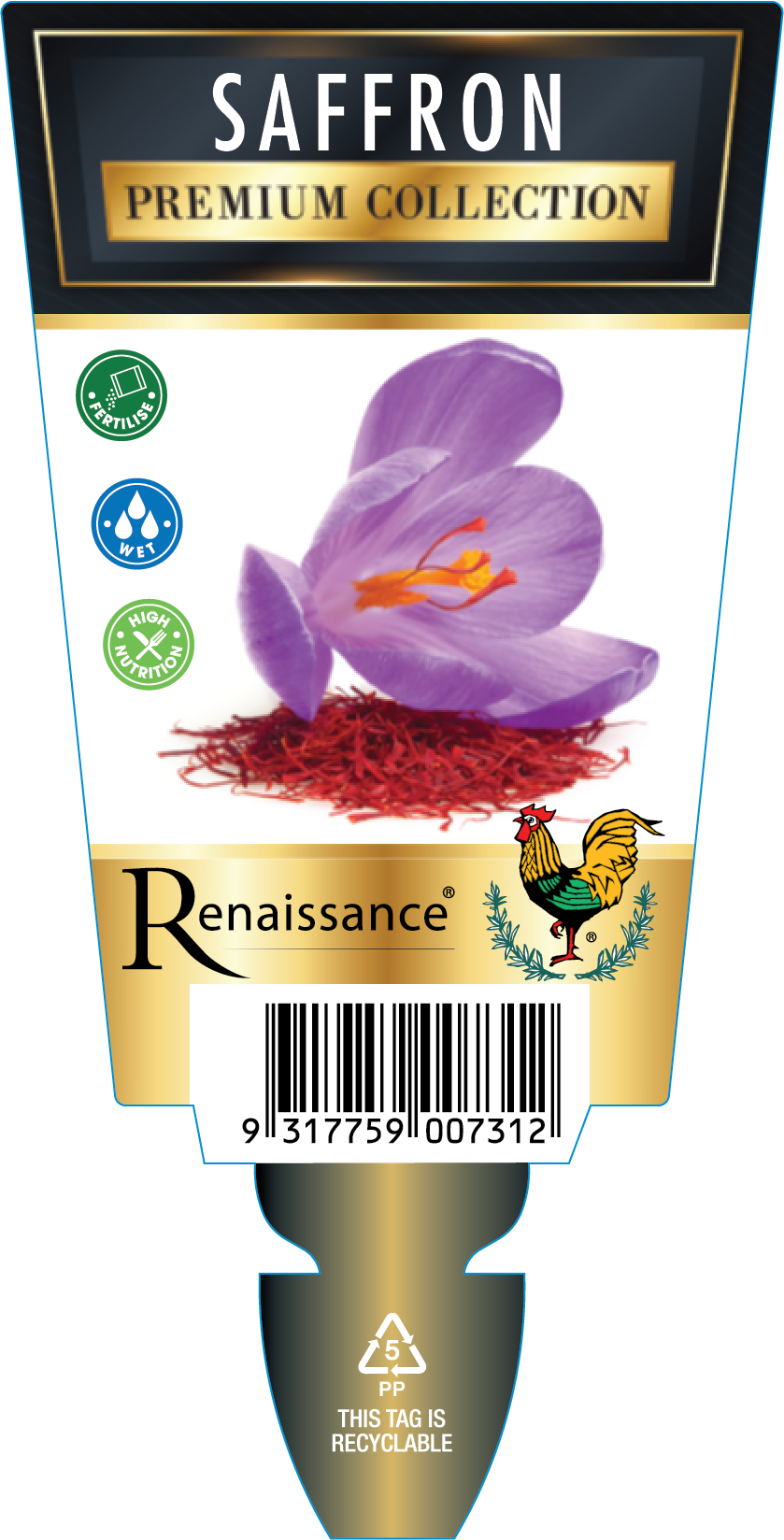
Description
(Crocus sativus)
There are many herbs in the Renaissance range. Some are essential to any good kitchen and others are quite exotic! Saffron is one of these and is a sterile type of Crocus from the eastern Mediterranean where it has been harvested for in excess of 3000 years The stunning purple flowers occur in mid-autumn as the grass like foliage also appears. Then in mid-spring the foliage dies back down to avoid the hot dry summer.
Flavours/Food Partners:
It is from these pretty flowers that you harvest the most precious of all spices. Indeed by weight it is many times more valuable than gold – and tastes nicer. The dried saffron can be used as a powder or an infusion. The latter is best and can be produced by soaking up to 30 stigmas in 50ml of hot water for 24 hours. Use in rice, couscous, a range of soups, fish, and Middle Eastern dishes.
Health/Cooking/Medicinal:
The stigmas in the scented Saffron flowers are dried and used in cooking for colou「and flavour, as a perfume, and as a medicine. They are delicate and thread-like, each 2.5 – 4 cm with a bright orange-red colour. The stigmas are harvested early in the morning before the flowers wilt and then dried as soon as possible – 1 oo•c for 3minutes or 45°C for 100 minutes. The dried saffron should be quickly put in a tight container in a cool, dark place.
Landscaping/Planting:
Saffron likes cool a wet spring followed by a hot dry summer and then a cooler moist autumn. They like a good well drained soft loam with plenty of sun and will tolerate cold frosty winters down to minus five degrees.
Cultivation/Fertiliser:
Fertilise with Seasol and Powerfeed in mid-autumn to mid spring.
Herb Attributes
| Position | FULL SUN, MODERATE FROST |
|---|---|
| Height | 40CM |
| Width | 35CM |